Design with Nature by Ian McHarg
Literary Impact

TITLE: Ian McHarg and Design With Nature – Literary Impact
AUTHOR: Jim Stokely
SOURCE: Ian McHarg, Design With Nature, published for the American Museum of Natural History by Doubleday & Company, 1969
PERMISSION to use granted by the author. Fair use for quotes and illustration from Design With Nature.
Landscape architect and planner Ian McHarg’s 1969 book, Design With Nature, has been widely and rightly praised as a book that revolutionized methods for thinking about and analyzing humans’ living relationship with the environment that surrounds and encompasses us all. Techniques such as map overlays and climate resilience analysis were modeled in specific case studies that galvanized future generations of architects, mapmakers, and urban planners.
But there is another way to view the treasures between the covers of Design With Nature: as a literary goldmine. Not only does the book maintain a balance between science on the one hand and humanism on the other; it does so with style and swagger.
The French author Marcel Proust began his great work In Search of Time Past by portraying his childhood vision of two paths diverging from the village of Combray: Swann’s Way and Guermantes Way. These two “ways” were for Proust two different lenses through which life could be seen.
Likewise, Scotsman Ian McHarg begins Design With Nature by describing his childhood between the city of Glasgow and the Scottish countryside:
I spent my childhood and adolescence squarely between two diametrically different environments, the poles of man and nature. Almost ten miles from my home lay the city of Glasgow, one of the most implacable testaments to the city of toil in all Christendom, a memorial to an inordinate capacity to create ugliness, a sandstone excretion cemented with smoke and grime. Each night its pall on the eastern horizon was lit by flames of the blast furnaces…
To the west the lovely Firth of Clyde widened down its estuary to the Atlantic Ocean…During all of my childhood and youth there were two clear paths from my home, the one penetrating further and further to the city and ending in Glasgow, the other moving deeper into the countryside to the final wilderness of the Western Highlands and Islands.
McHarg makes a point of not putting city over country; his real concern is nature at the hands of humanity: “It is not a choice of either the city or the countryside; both are essential, but today it is nature, beleaguered in the country, too scarce in the city, which has become precious.” In his beautiful third chapter entitled “The Plight,” McHarg focuses his venom on “the mercantile creed,” the unplanned highway, and classic economic analysis:
But what do we say now, with our acts in city and countryside? While I first addressed this question to Scotland in my youth, today the world directs the same question to the United States. What is our performance and example? What are the visible testaments to the mercantile creed – the hamburger stand, gas station, diner, the ubiquitous billboards, sagging wires, the parking lot, car cemetery, and that most complete conjunction of land rapacity and human delusion, the subdivision. It is all but impossible to avoid the highway out of town, for here, arrayed in all its glory, is the quintessence of vulgarity, bedecked to give the maximum visibility to the least of our accomplishments….
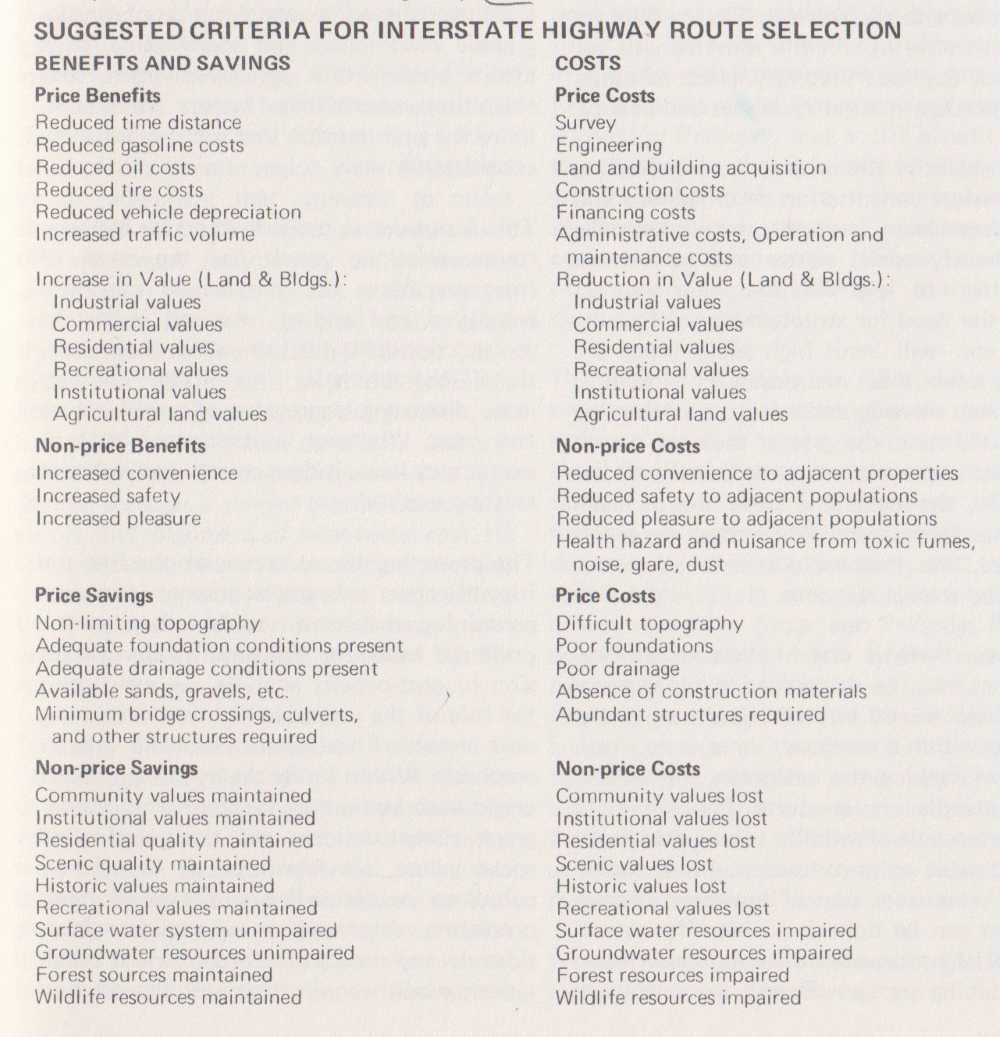
The economists, with a few exceptions, are the merchants’ minions and together they ask with the most barefaced effrontery that we accommodate our value systems to theirs. Neither love nor compassion, health nor beauty, dignity nor freedom, grace nor delight are important unless they can be priced. If they are non-price benefits or costs, they are relegated to inconsequence.
Had McHarg stopped there, Design With Nature would still stand as a clarion call to ecological activism. However, the author gives us fourteen more chapters filled with case studies and scientific validation. Perhaps you can read a copy; if not, here is one last peek between the book’s covers at a table showing the many factors that could be taken into account when planning where a highway should be built: